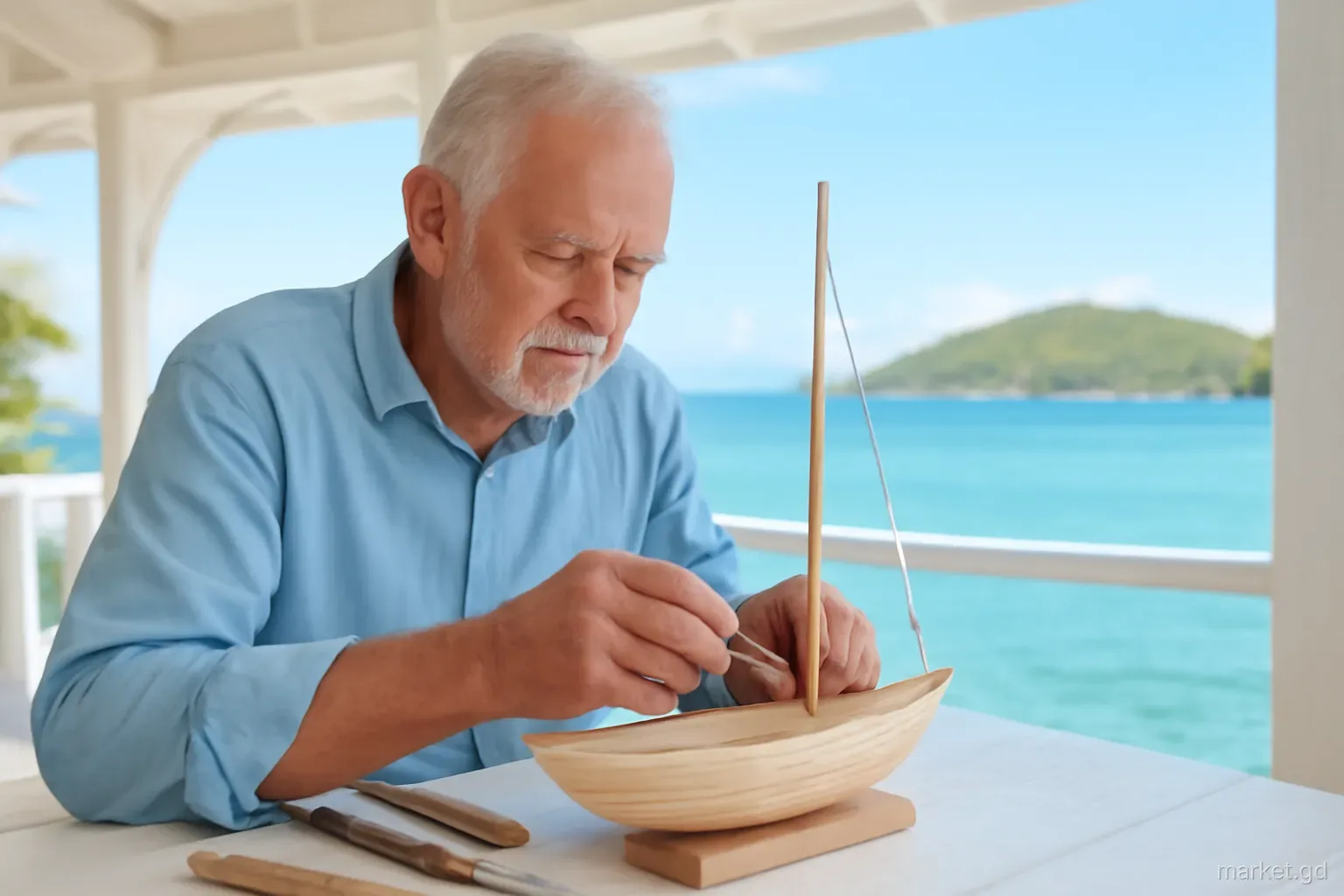
On Carriacou, wooden boats have been built by hand on the beach for well over a century, without drawings, using skills passed down through families in villages such as Windward. The full-sized sloops and schooners that came off those beaches carried cargo, fish and people around the Grenadines and beyond. Model boats grew out of the same tradition: scaled versions carved and rigged by the same families, raced by children at regatta time and sold to visitors as some of the most distinctive souvenirs anywhere in Grenada.
A well-made Carriacou model is a small piece of maritime history, not a trinket. This guide explains where the tradition comes from, the difference between display and sailing models, what to look for in workmanship, and how to get a fragile wooden boat home. Carriacou and Petite Martinique were hit very hard by Hurricane Beryl in July 2024, and many homes, workshops and boats were damaged, so check locally what is available before planning a trip around a purchase.
Where the tradition comes from
Boatbuilding on Carriacou is usually traced to the nineteenth century, when shipwrights of Scottish origin settled in the Windward area and passed their methods to local builders. Over generations the craft became thoroughly Carriacouan. Builders shaped hulls by eye, selected timber for its natural curves, and launched boats with ceremonies that blend Christian blessings with African-rooted traditions such as the Big Drum and a feast for the community.
The working boats served a practical economy. Carriacou has limited farmland and a long history of trading and fishing, and its sloops carried goods between Grenada, the Grenadines, Trinidad and other islands. Petite Martinique, a short distance away, shares much of the same maritime culture.
Fibreglass and imported vessels have reduced demand for large wooden boats, but the skills survive, and the Carriacou Regatta Festival, held around the start of August, keeps them visible. Model boats are part of that story. Children have long raced small sailing models in the shallows, and builders who once worked on full-sized hulls turned their hands to models for visitors, collectors and the regatta itself.
Display models and sailing models
Display models. Built to sit on a shelf. Emphasis is on accurate hull shape, fine rigging, painted detail and a stand. Sails may be cloth or a stiff material, and the rigging is often fixed. These are what most visitors buy.
Sailing models. Built to float and sail, with a weighted keel, working rudder and sails that can be trimmed. Model boat races are a traditional part of regatta celebrations on Carriacou. A sailing model can also be displayed, but it is designed around performance rather than decoration.
Half models. A hull cut in half along its length and mounted on a board. Historically, half models were a builder's tool for visualising a hull; as decorative pieces they hang flat on a wall and travel more easily than full models.
Sizes. Models range from small pieces that fit in a hand to large display boats a metre or more long. Larger models carry more detail but bring real problems in transport.
Types of vessel. Most models represent the local sloop, with a single mast and gaff or Bermuda-style rig, or a schooner with two masts. Some represent specific named boats, which makes them especially meaningful to people with family ties to Carriacou.
What to look for in workmanship
Quality varies from careful scale work to quick tourist pieces. A close look tells you a lot:
- Hull shape. A good hull is smooth and fair, with matching curves on both sides when viewed from the bow or stern. Lumps, flat spots or an obviously lopsided hull suggest a hurried job.
- Timber and finish. Hand-shaped wood shows grain and fine tool marks under the paint. A hull that looks moulded, with no grain or joins visible anywhere, may not be carved at all.
- Rigging. Lines should be taut, neatly tied and attached to fittings rather than glued in a tangle. Rigging is the most fragile part, so check it is secure.
- Paintwork. Carriacou boats are traditionally brightly painted, and models follow suit. Clean lines between colours and a smooth finish indicate care.
- Stand or cradle. A display model should come with a stable stand. Without one, it will roll on a shelf and the keel and rudder will be damaged.
- The maker. Ask who built it. Many builders are known by name in Windward and Hillsborough, and a model from a recognised family of builders carries more meaning.
Where to find them and when
The obvious place is Carriacou itself: Windward, the traditional boatbuilding village on the island's north-east coast, and Hillsborough, the main town, where shops and vendors have sold models to visitors. Some builders work from home and sell directly. Occasionally models are sold on mainland Grenada, in gift shops or at events, but choice there is narrower.
The Carriacou Regatta Festival, usually held around the August Emancipation holiday weekend, is the time when boats of every size are most visible and builders and sailors gather. The Carriacou Maroon and String Band Music Festival, usually held in the spring, and the Parang festival in December bring more visitors too, though neither is focused on boats.
After Hurricane Beryl, the situation on Carriacou and Petite Martinique has been one of rebuilding, and it is not possible to say which workshops and shops are operating at any given time. Ask your accommodation or a local contact in advance. If you do find a builder working, buying directly supports the recovery of a craft that depends on very few people.
Commissioning a model and talking about price
Some builders will make a model to order, which is the best way to get exactly what you want: a replica of a particular family boat, a specific rig, a chosen colour scheme or a size that fits a particular shelf. Expect to discuss details carefully, including the length of the hull, whether the masts should be removable, and how the finished model will reach you. A commission takes time, from days for a simple piece to weeks for a detailed replica, and a deposit is a reasonable request from the builder.
There is no fixed price list. Price depends on size, detail, the time involved and the reputation of the builder, and a large detailed model is a serious purchase rather than an impulse buy. Agree the total, the currency and the delivery arrangements before work starts, and keep a written note of what was agreed, even if it is only a message.
If the model is to be shipped after you leave, ask how it will be packed and who pays for shipping and any import charges at your end. Clear arrangements protect both sides, and builders who sell regularly to visitors will be used to these questions.
Getting a model boat home safely
Wooden models with masts and rigging are among the hardest souvenirs to transport. Planning ahead avoids a broken mast on arrival:
- Ask the builder whether the masts can be removed or lowered for travel. Some models are made with removable masts for exactly this reason.
- Request a sturdy box sized to the model, with the hull held firmly so it cannot slide. Builders who sell regularly to visitors usually know how to pack.
- Wrap the hull in soft cloth and pad around the rigging with tissue or foam, never with anything that can snag the lines.
- Carry small and medium models as hand luggage, where they will not be thrown about. The ferry between Grenada and Carriacou is a point of risk too; keep the box with you.
- For large models, ask about shipping by courier or freight, get the cost in writing, and photograph the packed model before handing it over.
- Declare wooden items if your home country asks. Finished, painted wood is usually unproblematic, but some countries inspect untreated timber.
Frequently asked questions
Why are model boats associated with Carriacou?
Carriacou has a long tradition of hand-building wooden sloops and schooners on the beach, centred on Windward. Model boats come from the same families and skills, and model boat races are part of the island's regatta celebrations.
Can Carriacou model boats actually sail?
Some can. Sailing models have a weighted keel, rudder and adjustable sails and are raced at regatta time. Most models sold to visitors are display models built for detail rather than performance, so ask which type you are buying.
When is the Carriacou Regatta Festival?
It is usually held around the start of August, linked to the Emancipation holiday. Dates vary from year to year and the event was affected by Hurricane Beryl in 2024, so confirm the programme with local organisers or tourism bodies before booking.
Is it possible to buy Carriacou model boats on mainland Grenada?
Occasionally, in gift shops or at events, but the choice is far wider on Carriacou itself. If you cannot travel to Carriacou, ask galleries and craft shops in St George's whether they stock models or know a builder.
How do you carry a model boat on a plane?
Ask for removable masts, pack the hull firmly in a box with soft padding around the rigging, and carry it as hand luggage if it fits your airline's cabin size. Larger models are better shipped professionally.