Grenadian markets change character through the year. In late spring the tables fill with mangoes and the air smells of ripe fruit; in the later summer avocados, locally called zaboca, take over; by December the stalls are red with sorrel and green with pigeon peas. Shoppers who know the rhythm eat better and pay less, buying each crop when it is plentiful rather than paying a premium for the first or last of the season.
This calendar sets out the broad pattern for Grenada's main produce. It is a guide rather than a timetable. Seasons shift with rainfall, elevation and the age of the trees, a crop may start weeks earlier in the dry south than in the wet interior, and a storm or drought can move everything. Use it to know what to look for, then let the market tell you what is actually ripe this week.
January to March: dry weather, citrus and provisions
The new year opens in the dry season. Citrus is a feature of the early months, with oranges, grapefruit and tangerines (often sold as portugal) from the end of the previous year continuing on many stalls, along with limes, which are rarely absent for long. Pigeon peas, harvested from the Christmas period, carry on into the early months, both fresh in the pod and shelled.
Ground provisions are strong. Yams planted at the start of the previous rainy season are reaped from around the end of the year into the early months, and sweet potatoes, dasheen, tannia and cassava are widely available. Sorrel tails off after Christmas. Dry weather tends to reduce leafy greens such as callaloo and lettuce, especially on farms without irrigation, so prices for salad crops can firm as the dry season goes on. Tamarind pods ripen around this time in many areas, and out at sea the pelagic fishing season brings tuna, dolphinfish (mahi-mahi) and kingfish to the fish markets.
April to June: the mango months begin
As the dry season peaks, the first mangoes appear, and by May and June mango season is in full swing, with varieties such as Julie and Ceylon on every stall and roadside table. Prices that were high for the first fruit fall steadily as more trees bear. Plums of several kinds come in around the same period, along with cashew fruit in some areas.
This is also a hard time for vegetables in dry years, since many small farms depend on rain. Tomatoes, cucumbers and greens can be scarce and expensive until the rains return. When the rainy season breaks, usually around June, planting begins, and corn and peas go into the ground. Late June brings Fisherman's Birthday in Gouyave, and fish demand around that festival is strong. Breadfruit is available through much of the year, but supply rises and falls, and some weeks see heaps of it while others see few.
July to September: avocados, breadfruit and the rains
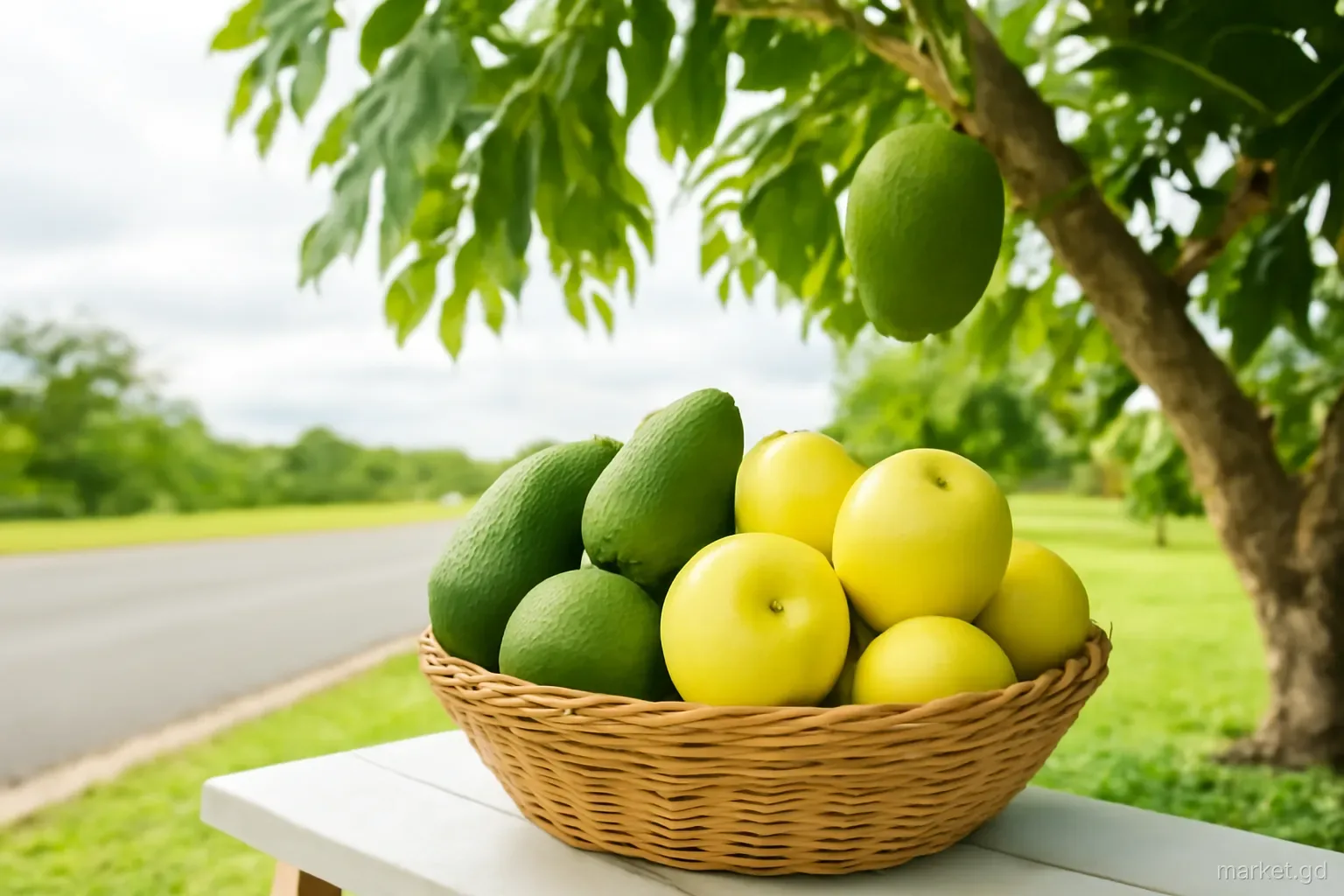
The mango season winds down through July and August, with later varieties finishing the run. Avocados take over: zaboca season generally runs from around the middle of the year into the autumn, and large green fruit appear on every market table and roadside stand. Prices fall sharply at the peak, and a single avocado can feed a family.
Rain brings vegetables back. Callaloo, lettuce, bok choy, herbs, christophene, pumpkin and green beans become more plentiful, though very heavy rain can damage tender crops and make some farms hard to reach. Fresh corn, roasted at the roadside or boiled for sale, appears from crops planted at the start of the rains. Spicemas in August lifts demand for drinks, fruit and ingredients for street food. This is also the heart of the hurricane season, and any storm can disrupt supply suddenly.
October to December: golden apples, citrus and Christmas crops
The later months are a period of transition. Avocados continue into the autumn in many areas, golden apples become more common, and citrus starts to return towards the end of the year. Soursop, carambola (five finger) and guava appear in varying quantities through the wet months.
December is defined by Christmas. Sorrel, which flowers as the days shorten, becomes the defining crop of the season and is sold in bundles of fresh calyces for the traditional drink. Pigeon peas come in for the Christmas table, and ginger is in demand for ginger beer and seasoning. Demand for ham, baking ingredients and dried fruit drives prices up in shops and supermarkets in the weeks before Christmas, while local fresh produce is often plentiful but in high demand in the final days.
Available most of the year
Some staples are on Grenadian stalls in most months, though price and quality still move with the weather:
- Bananas and figs (green bananas for cooking), plantains and breadfruit, with breadfruit supply rising and falling through the year.
- Ground provisions such as dasheen, tannia, sweet potato and cassava, though yams are seasonal.
- Coconuts, sold dry for cooking and green for coconut water from carts and roadside stalls.
- Seasonings: chive, thyme, celery, seasoning peppers, hot peppers, garlic and ginger.
- Spices: nutmeg, mace, cinnamon, cloves, bay leaf and turmeric, since dried spices keep and nutmeg is gathered across much of the year.
- Limes, which are rarely absent, though prices rise in dry spells.
- Pumpkin and christophene, more abundant in wetter months but seldom missing entirely.
How prices follow the seasons
Local produce prices in Grenada follow supply far more than they follow anything else. A crop at the start of its season is scarce and priced high; at the peak, when many farms bear at once, prices drop and heaps grow; at the tail, prices climb again for the last good fruit. The same pattern repeats for mangoes, avocados, plums, sorrel and pigeon peas, and for vegetables it is tied closely to rainfall.
Imported produce behaves differently. Apples, grapes, onions, potatoes, carrots and cabbage arriving by sea are priced by world markets, freight and the exchange rate of the US dollar, to which the Eastern Caribbean dollar is pegged at EC$2.70 to US$1. Their prices move less with Grenada's seasons but can jump when shipping costs rise. Supermarkets blend the two, so a local tomato may be cheaper than an imported one in the wet months and dearer at the end of a long dry season. For the household budget, the rule is simple: build meals around whatever local crop is at its peak, and lean on long-keeping imports only when local supply is thin. Holiday weeks, especially Christmas and Easter, add a demand spike on top of the seasonal pattern.
Using the calendar and its limits
A calendar can only show the general shape. Grenada's rainfall varies a great deal between the drier south and south-west and the wetter interior and east, and between years. A long dry season delays planting and shortens the vegetable supply; an unusually wet one can rot fruit on the tree. Trees at higher elevations in parishes such as St John, St Andrew and St David often fruit later than those near the coast.
Shocks matter even more. Hurricane Ivan in 2004 destroyed a large share of the island's tree crops, including nutmeg, and some took years to recover. Hurricane Beryl in 2024 hit Carriacou and Petite Martinique hard and damaged crops in parts of the mainland. After events like these, local produce can be scarce and imports fill the gap at higher prices. The best approach is to use the calendar as a guide, ask vendors what is coming in, and watch heap sizes: when a heap of plums or tomatoes suddenly doubles for the same price, the season has peaked.
Frequently asked questions
When is mango season in Grenada?
Mangoes appear in the late dry season, with the main season running roughly from May through July and some varieties continuing into August. Timing varies by variety, location and rainfall, and early fruit costs noticeably more than fruit at the peak of the season.
When can avocados be found in Grenadian markets?
Zaboca season generally runs from around the middle of the year into the autumn, with prices lowest at the peak. A few early or late trees mean avocados can turn up outside that window, usually at higher prices.
Why are vegetables expensive in Grenada in the dry season?
Many small farms rely on rainfall rather than irrigation. In a long dry season, tomatoes, lettuce, cucumbers and callaloo become scarce, and imported vegetables, which cost more, fill the gap. Prices usually ease once the rains return and new crops mature.
When is sorrel available?
Sorrel is a short-day plant that flowers as the days shorten towards the end of the year. Fresh sorrel is mainly a November and December crop, peaking just before Christmas when demand for the traditional drink is highest.
Is breadfruit available all year?
Breadfruit can be found in most months, but supply rises and falls through the year. In heavy weeks it is cheap and plentiful; in lean weeks fewer trees are bearing and prices rise. Roasted breadfruit stays popular whatever the season.
Does the produce calendar apply to Carriacou too?
The broad pattern is similar, but Carriacou is drier than the mainland and grows less fresh produce, so much is shipped from Grenada. After Hurricane Beryl in 2024, local supply on Carriacou and Petite Martinique was badly affected; check current availability locally.