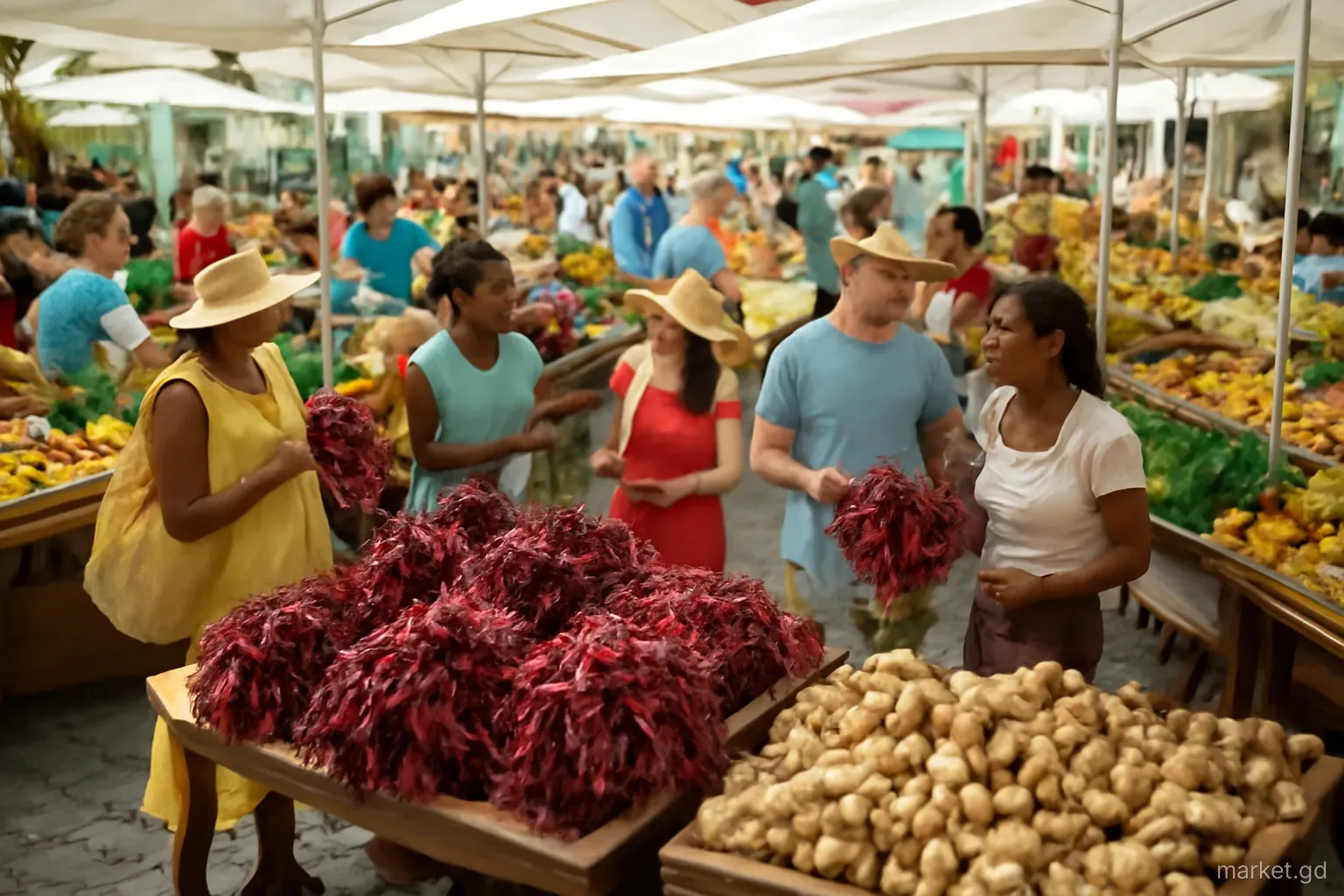
Outside St George's and Grenville, Grenada's towns are small, and so are their markets. In Gouyave, Victoria and Sauteurs, buying food is spread across a modest market area, a fish landing, a few shops and a string of roadside stalls and vans. There is no single square to head for, and the rhythm follows the fishing boats and the farmers of the surrounding hills.
This page explains how food shopping works in the three main towns of the west and north, what is worth looking for in each, and how to buy well when there is no big market to fall back on. It is aimed at people staying on the quieter side of the island and travellers driving the west coast road.
How small-town markets differ from St George's
In the capital, hundreds of vendors gather in one place on a Saturday. In the small towns of St John, St Mark and St Patrick, trade is more scattered. There is usually a public market building or vending area in each town centre, but a lot of produce is sold elsewhere: from tables outside homes, from a vendor under a tree at a junction, from the back of a pickup, or from a small shop that stocks a few local items beside imported groceries.
Supply is also more local and more seasonal. What is on sale in Victoria on a given morning is largely what grew in the hills of St Mark that week. You will see less variety than in St George's, but the produce is often picked closer to the time of sale.
Fish is a larger part of the picture. Gouyave in particular is a fishing town, and in all three towns the boats coming in shape what people cook. Market days in these towns are best understood as a pattern of several small trades rather than one event.
Relationships matter even more than in the capital. In a town of a few thousand people, vendors know their customers, and a visitor who stops regularly at the same table during a long stay will soon be recognised. Many sellers are farmers selling their own crop rather than resellers, which means they can tell you exactly where and when something was picked, and whether more is coming next week.
Gouyave, St John
A fishing town first. Gouyave is the main town of St John and one of Grenada's best-known fishing communities. Much of the daily food trade revolves around the catch, and the town is known for its weekly Friday evening street food event built on fish.
The nutmeg connection. The nutmeg processing station in Gouyave reflects the parish's long role in spice production. Spices are easy to find in town, often in simple bags from local sellers.
Produce from the hills. Farms above the town supply bananas, provisions, breadfruit, citrus and seasonal fruit, sold in small quantities around the town centre and along the main road.
Best time. Mornings for produce and fish landings; Friday for the most activity. Saturday morning is also lively as people shop for the weekend.
Victoria, St Mark
Grenada's smallest parish. St Mark is the smallest parish, and Victoria is a compact town on the west coast between Gouyave and the north. Its market trade is small and closely tied to the farms of the valleys behind it.
Produce close to source. The steep, wet hills of St Mark rise towards Mount St Catherine, Grenada's highest peak. Ground provisions, bananas, cocoa and fruit come down from these areas, and some are sold right in town.
Fish from the bay. Boats work from the shore here too, and fish may be sold near where it lands. Timing depends on when boats come in and how the sea has been.
Practical tip. Victoria is a good stop on a west coast drive to buy fruit and seasoning for the day, rather than a destination for a large shop.
Sauteurs, St Patrick
The northern town. Sauteurs is the main town of St Patrick, at the northern tip of the main island. It is known for Leapers' Hill, the clifftop site associated with the last Kalinago resistance to the French in the seventeenth century.
A farming hinterland. St Patrick has drier and flatter areas than the central mountains, along with cocoa and fruit-growing districts. Market produce reflects that mix, and roadside sellers are common on the roads approaching town.
Fish and the north coast. Fishing boats operate along the north coast, and fish is sold locally depending on the catch.
Practical tip. Sauteurs is a long drive from the south. If you come for the market, arrive early and combine it with sights in the north rather than making a special return trip.
What is worth buying along the coast road
The west coast road from St George's to Sauteurs passes through farming and fishing country the whole way, and some of the best buying happens between the towns rather than in them. Look out for avocados in season, which grow well on the leeward hillsides and are sold by the piece or in small heaps. Bananas, plantain and breadfruit are common. Citrus, including limes and sometimes local oranges and grapefruit, turns up at roadside tables.
Spices are the other obvious purchase. St John and St Mark have long grown nutmeg and cocoa, and local sellers offer nutmeg, mace and cinnamon in simple bags, usually at lower prices than the decorated baskets sold to cruise passengers in town. Cocoa balls for cocoa tea are sometimes available. Buying a few whole nutmegs straight from the area that grew them is one of the simplest and most practical souvenirs of a drive up the coast.
Seasoning bundles of chive, thyme and peppers are worth picking up if you are cooking that evening, since they wilt quickly in a hot car.
How to shop well in the small towns
Without a large central market, a little technique helps you find what you need.
- Arrive in the morning. Produce sells out and fish disappears quickly; afternoons are thin.
- Start in the town centre at the public market or vending area, then look along the main road on the way in and out.
- Ask a vendor where to find what you cannot see. People know who has avocados this week or when the boats came in.
- Buy for the next day or two, not the week. Choice is narrower and many items are picked ripe.
- Carry small EC dollar notes. Change is limited, and there may be no ATM nearby when you need one.
- Bring a cool bag for fish and anything soft, especially on a hot drive back south.
- Combine your stops. A morning on the west coast can take in Gouyave, Victoria and Sauteurs if you drive steadily and keep each stop short.
Pitfalls on the west and north coast
Most problems come from expecting St George's in miniature.
- Expecting a big Saturday market. Each town has some trade on Saturday, but nothing on the scale of Market Square. Adjust expectations and you will enjoy it more.
- Arriving mid-afternoon. Many vendors are home by then. Fish especially is a morning business.
- Relying on card payment. Small traders deal in cash. Plan your cash before you leave the south.
- Parking carelessly. The west coast road runs through the centre of each town and is narrow. Parking on it blocks buses and trucks; find a side street.
- Forgetting the time back. The drive from Sauteurs to the south takes time on winding roads. Factor it in before buying fish or soft fruit that needs a fridge.
- Assuming everything is open. Vending patterns change with season, weather and individual circumstances. Check locally rather than relying on old information.
Frequently asked questions
Is there a market in Gouyave?
Yes. Gouyave has a market area in the town centre, plus fish sold close to where boats land and produce on roadside stalls. It is small compared with St George's. The town is busiest on Friday, when its weekly evening fish-based street food event takes place, and on Saturday mornings.
What is the best day to shop in Sauteurs or Victoria?
Saturday morning is generally the liveliest, with Friday also active. Weekday mornings still offer produce and, depending on the boats, fish. Afternoons are thin in both towns. Because trade is small and local, it pays to arrive early and ask vendors what is coming in.
Can you buy fresh fish directly from fishermen on the west coast?
Often, yes. In fishing communities along the west and north coast, fish is sold near the landing as boats come in. What you find depends on the day's catch and sea conditions, and quantities can be limited. Bring a cool bag and cash.
Are there supermarkets outside St George's?
Yes, each of the main towns has shops and smaller supermarkets stocking imported groceries alongside some local goods. Choice is narrower than in the large supermarkets of the south, so residents of the west and north often combine local shopping with occasional trips to town.
Is it worth driving the west coast just for the markets?
On its own, probably not. Combined with the coast road, Gouyave's nutmeg station, the north's historic sites and a few beaches, the small-town markets add a lot. They show everyday food life far from the cruise crowds and are a good place to buy fruit for the day.
Do roadside fruit stalls charge tourist prices?
Most roadside sellers charge similar prices to locals, especially if you greet them, ask the price before choosing and pay in EC dollars. Prices are higher for out-of-season fruit and after storms. If a price seems high, ask politely about a smaller quantity rather than haggling hard.